
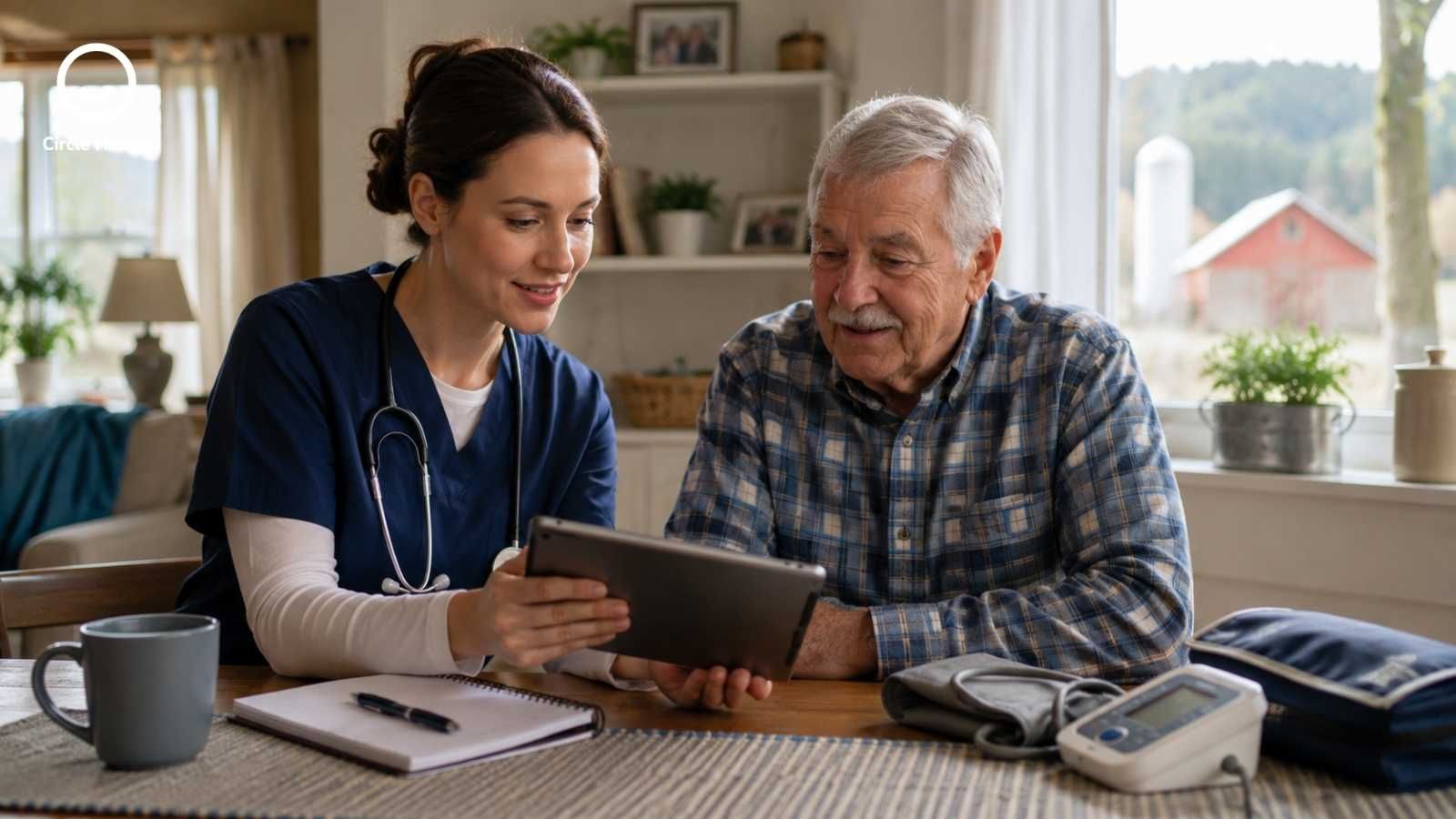
Learn how the Rural Health Transformation Program helps rural providers invest in CCM, PCM, RPM, and care management technology for better outcomes.
Rural communities are about to receive one of the largest infusions of federal healthcare funding in a generation. The Rural Health Transformation (RHT) Program has committed roughly $50 billion to help states rebuild rural healthcare delivery, and every state has an approved plan in motion.
For Rural Health Clinics (RHCs), Federally Qualified Health Centers (FQHCs), and independent rural practices, the real work now is figuring out where that money should go. Facility upgrades matter, but care management infrastructure - the systems and staffing that let existing teams manage more patients well - offers one of the fastest, most measurable paths to the outcomes CMS is asking states to deliver. At Circle Health, this is exactly where we help rural providers focus their investment.
Goals of the Rural Health Transformation Program
The RHT Program is built around five strategic goals, grounded in the statutorily approved uses of the funds: Make Rural America Healthy Again, sustainable access, workforce development, innovative care, and technology innovation.
Together, these goals push states toward a common outcome - care that reaches patients earlier, closer to home, and through systems that don't collapse once the initial grant funding runs out. States are expected to fold the goals into a detailed rural health transformation plan that also addresses statutory requirements around access, quality, and outcomes.
For providers, this framework matters because it shapes what state plans will actually fund. Programs that clearly support prevention, coordination, and remote care delivery tend to align closely with what states are prioritizing.
How Rural Health Clinics Can Access RHT Program Funding?
RHT dollars don't flow directly from CMS to individual clinics - they move through each state's approved transformation plan. CMS distributes the full $50 billion over five fiscal years, from 2026 through 2030, at roughly $10 billion per year. Half of that is split equally across all 50 states; the other half is allocated based on factors like rural population, facility count, and the strength of each state's proposed initiatives, as detailed in CMS's announcement of the state awards.
Many states have already started distributing funds during the summer of 2026, while others are still accepting applications and are expected to make funding decisions in the fall of 2026. This means Rural Health Clinics should monitor their state's program timelines and funding announcements to avoid missing application opportunities.
For an RHC to benefit, it typically needs to engage with its state health department or Medicaid agency to understand what the approved plan funds and how local providers can apply, partner, or participate. Many states have already built care management, remote monitoring, and data-sharing infrastructure directly into their plans - which means providers investing in those capabilities now may be well positioned to align with state funding priorities as they roll out.
Why Care Management Is the Smartest Investment for RHT Funding
Care management programs are a practical, provider-level way to act on what the RHT Program is funding at the state level. Three Medicare-supported models are especially well suited to rural settings:
- Chronic Care Management (CCM): Ongoing, non-visit-based support for patients managing two or more chronic conditions.
- Principal Care Management (PCM): Focused monitoring for patients with a single high-risk condition.
- Remote Patient Monitoring (RPM): Connected devices that let care teams track vitals and symptoms between appointments.
These models matter more in rural areas because the traditional safety net is thinner there. When the nearest specialist is an hour away, a monthly check-in call or a remotely monitored blood pressure reading can be the difference between a manageable condition and an ER visit. Transitional Care Management (TCM) fills a related gap, supporting patients in the vulnerable window right after a hospital discharge.
Independent care management organizations have already shown what this looks like in practice. In south-central Texas, one nurse-led group with a limited clinical footprint substantially expanded its enrolled patient base within a year, while also improving patient retention and outreach success - proof that the right combination of people and process can scale rural care without a proportional increase in staff.
How Care Management Supports the Rural Health Transformation Program's Goals
Improving Rural Health Through Preventive and Coordinated Care
This goal centers on prevention and addressing the root causes of poor health outcomes in rural communities - and care management programs are built to do exactly that.
- Promoting evidence-based prevention and management: CCM and PCM give care teams a structured way to monitor chronic conditions continuously, rather than only at scheduled visits, catching problems before they escalate.
- Creating new access points and addressing behavioral health: Remote, non-visit-based check-ins function as an additional access point for patients who can't easily reach a clinic, including support for behavioral health needs.
- Create structure for innovative care: Standardized care management workflows give clinics a repeatable framework for testing new prevention and chronic disease models.
- Promote flexible, lower-cost care: Remote monitoring and phone-based outreach reduce the cost and travel burden associated with in-person-only care.
- Improve outcomes and add value: Consistent outreach and earlier intervention support the kind of measurable outcome improvement the RHT Program is designed to reward.
Using Technology to Expand Rural Care Delivery
Technology adoption is one of the five strategic goals in its own right, and care management software is a direct, practical expression of it. A capable platform supports CCM, PCM, and RPM by giving clinical teams a unified patient view, automated compliance and billing safeguards, and reporting that connects clinical activity to financial performance.
It also enables the kind of data sharing the RHT Program encourages - between care teams, referring providers, and broader state health infrastructure - which is foundational to the hub-and-spoke and regionally coordinated care models many states are building into their plans. For rural clinics, adopting this kind of technology isn't just an operational upgrade; it's a direct answer to one of the program's core funding priorities.
Turning Short-Term Funding Into Long-Term Rural Healthcare Capacity
Grant funding is temporary by design. The organizations that get the most out of the RHT Program won't be the ones that spend it fastest - they'll be the ones that use it to build lasting capacity: trained staff, repeatable workflows, and technology that supports a growing patient panel without a proportional rise in overhead.
If your organization is weighing how to prioritize RHT investment, Circle Health's clinical advisory team offers a focused opportunity assessment - a practical look at where your current care management approach stands today and where the highest-impact gaps are.
Conclusion
The Rural Health Transformation Program represents more than a funding initiative; it is an opportunity for rural healthcare organizations to build stronger, more sustainable models of care. By investing in technology-enabled care management programs such as CCM, PCM, RPM, and TCM, Rural Health Clinics, FQHCs, and independent practices can improve care coordination, support patients with chronic conditions, reduce avoidable hospital visits, and strengthen long-term financial sustainability. Organizations that use RHT funding to develop scalable workflows, equip their teams with the right technology, and create lasting operational capacity will be better positioned to deliver high-quality, patient-centred care long after the federal funding period ends.
Frequently Asked Questions
What is the Rural Health Transformation Program?
It's a $50 billion federal initiative, authorized under Public Law 119-21, that provides funding to all 50 states to strengthen rural healthcare delivery. States use these funds to expand access, improve quality, and modernize healthcare infrastructure. CMS oversees the program through its Office of Rural Health Transformation.
How much funding is each state receiving?
CMS is distributing the $50 billion over five fiscal years, from 2026 through 2030, with approximately $10 billion available each year. First-year state awards have averaged around $200 million, ranging from $147 million to $281 million, depending on each state's approved implementation plan.
Can Rural Health Clinics use RHT funds for care management software?
Yes. Technology investment is one of the RHT Program's core priorities, particularly solutions that support care coordination, remote patient monitoring, and digital healthcare delivery. Many state plans include investments in care management infrastructure, though clinics should verify eligibility through their state's approved RHT proposal.
What's the difference between CCM, PCM, and RPM?
Chronic Care Management (CCM) supports patients with two or more chronic conditions through ongoing, non-face-to-face care. Principal Care Management (PCM) focuses on patients with a single complex condition requiring specialized management. Remote Patient Monitoring (RPM) uses connected medical devices to monitor patients' health data between office visits.
Do these programs actually reduce ER visits?
Yes. Regular patient outreach, proactive care coordination, and remote monitoring help identify health issues before they become emergencies. Many rural care management programs have reported improved patient engagement and fewer avoidable emergency department visits, although results depend on program design and patient population.
How can a small rural practice get started without adding staff?
A care management platform can automate patient enrollment, documentation, compliance, and reporting, allowing existing staff to focus on patient care rather than administrative work. Many practices begin with a small pilot program before expanding as they build experience and capacity.
Where can I find official details on the RHT Program?
The official CMS Rural Health Transformation Program resources provide the latest information on program goals, funding timelines, and state implementation plans. CMS newsroom announcements also publish state award amounts and approved proposals.
How can Circle Health help organizations maximize RHT funding?
Circle Health helps healthcare organizations build scalable care management programs through technology, workflow optimization, and clinical support. By implementing CCM, PCM, RPM, and other coordinated care solutions, organizations can use RHT funding to strengthen long-term care delivery and operational efficiency.