

Explore care management offerings in value-based care, including CCM, RPM, PCM, BHI, and TCM. Learn their definitions, core components, and how they improve outcomes and financial performance.
Value-based care has reshaped how healthcare organizations measure success. Instead of focusing solely on visit volume, providers are increasingly evaluated on patient outcomes, quality metrics, and cost efficiency.
To perform well under this model, organizations must manage patients continuously — not just during appointments. This is where care management offerings play a central role.
Care management programs create structured systems to coordinate care, monitor high-risk populations, close gaps, and improve measurable outcomes. They form the operational backbone of successful value-based strategies.
This guide explains what care management offerings are, how they work, and the clinical, operational, and financial benefits they provide.
Understanding Value-Based Care
Value-based care is a reimbursement model in which payment is tied to patient outcomes rather than the volume of services delivered.
Organizations are increasingly evaluated on:
- Hospital readmission rates
- Chronic disease control metrics
- Preventive care adherence
- Total cost of care
- Patient engagement and satisfaction
Meeting these expectations requires structured oversight of patient populations — particularly those with chronic conditions or high utilization risk. Care management offerings provide that structure.
What Are Care Management Offerings?
Care management offerings are organized clinical programs designed to support patients outside traditional face-to-face visits. They involve proactive outreach, coordination between care teams, and continuous monitoring.
Rather than reacting to acute events, these programs aim to prevent them.
Most care management offerings include:
- Patient identification and enrollment
- Comprehensive care plan development
- Medication review and adherence monitoring
- Regular patient engagement
- Risk-based monitoring and escalation
- Documentation aligned with regulatory standards
These programs are especially valuable for Medicare populations and patients with chronic or complex conditions.
Major Types of Care Management Programs
Several structured programs support value-based objectives. Each addresses a different patient need while contributing to improved quality performance.
1. Chronic Care Management (CCM)
Chronic Care Management supports patients with two or more chronic conditions expected to last at least 12 months.
Core elements include:
- Monthly non-face-to-face care coordination
- Comprehensive, shared care plans
- Medication management
- Ongoing patient communication
- Time tracking and documentation
By maintaining consistent oversight, CCM reduces exacerbations and improves chronic disease stability.
2. Remote Patient Monitoring (RPM)
Remote Patient Monitoring uses connected devices to track health metrics between visits.
Common data points include:
- Blood pressure
- Blood glucose
- Weight
- Oxygen saturation
RPM enables earlier intervention when abnormal readings occur, helping prevent avoidable hospitalizations.
3. Principal Care Management (PCM)
Principal Care Management focuses on patients with a single, high-risk chronic condition requiring intensive oversight.
Unlike CCM, which addresses multiple conditions, PCM concentrates deeply on one complex diagnosis.
Key components include:
- SMART goal-based care plans
- Risk-based monitoring
- Ongoing outreach
- Social determinants assessment
PCM is particularly relevant in specialty practices managing advanced disease states.
4. Behavioral Health Integration (BHI)
Behavioral Health Integration embeds mental health screening and support into primary care workflows.
Programs typically include:
- Validated screening tools such as PHQ-9 and GAD-7
- Care plan development
- Medication coordination
- Ongoing progress tracking
Because behavioral health strongly influences physical outcomes, BHI supports whole-person care and improved chronic disease management.
5. Transitional Care Management (TCM)
Transitional Care Management supports patients during the high-risk 30-day period following hospital discharge.
This program focuses on:
- Timely post-discharge contact
- Medication reconciliation
- Follow-up appointment coordination
- Documentation of services
TCM directly addresses hospital readmission risk, a critical quality measure in value-based contracts.
Core Components Across All Care Management Programs
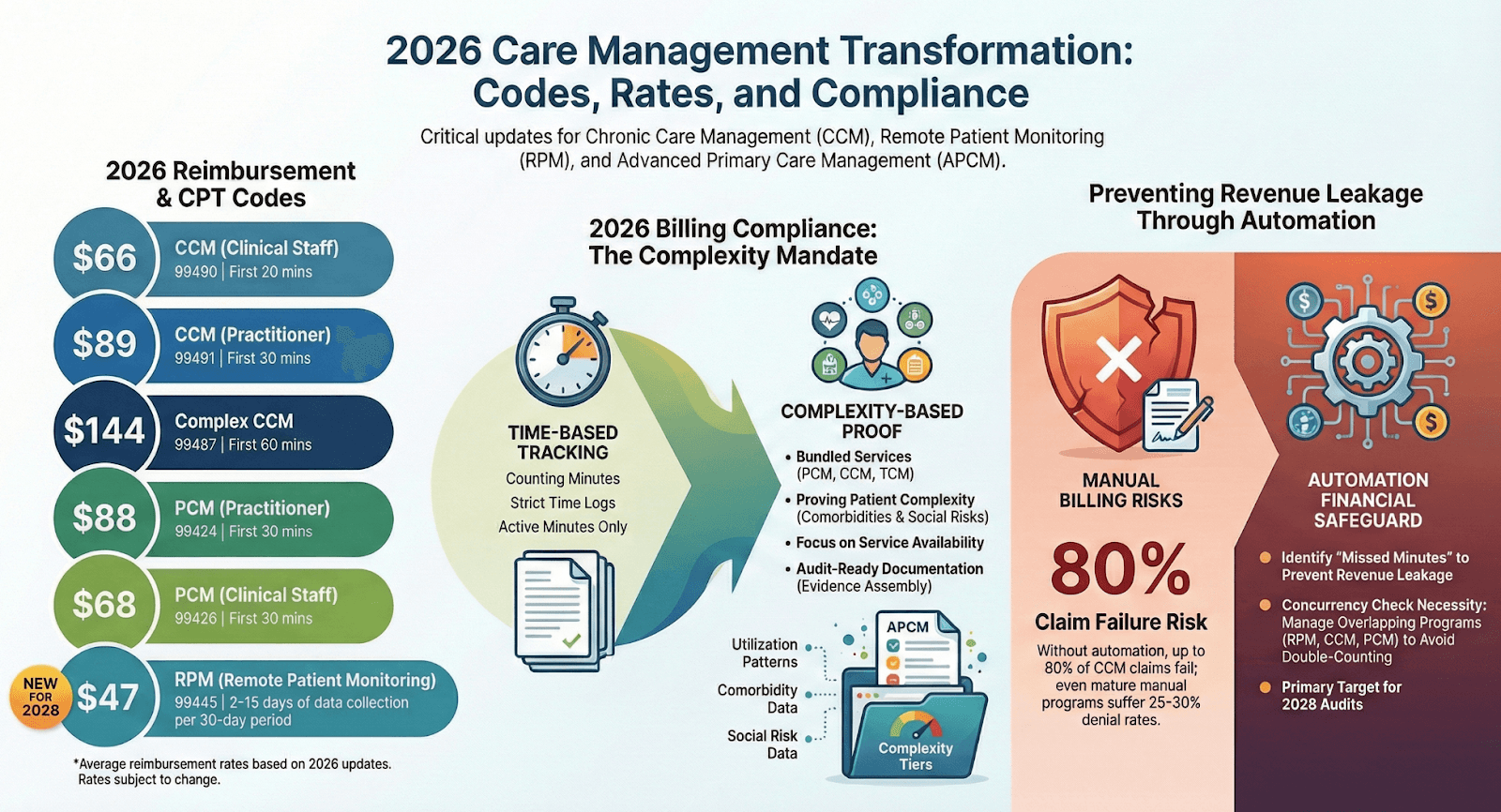
Although each program targets different patient needs, successful care management offerings share foundational elements. These components determine whether programs produce measurable impact.
1. Risk Stratification
Care management begins with identifying which patients will benefit most. Risk stratification uses clinical history, utilization patterns, and social factors to segment populations by need.
This ensures resources are directed toward patients most likely to experience complications without intervention.
2. Structured Workflows
Standardized processes guide teams through enrollment, outreach, documentation, and escalation. Clear workflows reduce variability and improve reliability.
Defined touchpoints ensure patients are not overlooked between visits.
3. Integrated Technology
Effective programs rely on systems that integrate with electronic health records and allow centralized tracking of:
- Patient interactions
- Monitoring data
- Alerts
- Care plan updates
- Time logs
Without visibility, proactive intervention becomes difficult.
4. Clinical Oversight
Licensed clinical professionals play a critical role in reviewing data, adjusting care plans, and escalating concerns. Care management is not simply administrative coordination — it requires clinical judgement.
5. Compliance Infrastructure
Programs operating under CMS reimbursement models require accurate documentation, consent capture, and billing alignment. Structured compliance systems protect organizations from audit risk and ensure sustainability.
Benefits of Care Management in Value-Based Care
Care management programs provide multi-dimensional benefits that align closely with value-based performance metrics.
Clinical Benefits
Care management strengthens patient stability by extending support beyond office visits. Ongoing monitoring and regular engagement allow providers to intervene early, reducing complications and acute events.
This continuity improves overall health outcomes and enhances chronic disease control.
Key clinical benefits include:
- Reduced hospitalizations and readmissions
- Improved chronic condition management
- Earlier detection of deterioration
- Better medication adherence
- Enhanced behavioral health screening.
Operational Benefits
By introducing structured workflows and centralized tracking, care management reduces fragmentation across care teams. Instead of reactive coordination, organizations operate within defined processes.
This improves consistency and reduces administrative burden.
Operational improvements may include:
- Standardized documentation
- Clear accountability for follow-up
- Improved communication across teams
- Scalable population oversight
- Reduced manual tracking.
Financial Benefits
Value-based reimbursement models reward quality and cost control. Care management programs support these goals while also unlocking structured reimbursement opportunities under CMS guidelines when eligibility requirements are met.
Financial benefits may include:
- Recurring reimbursement streams
- Reduced penalties tied to readmissions
- Improved performance in ACO contracts
- Protection from downside risk
- Stronger referral positioning.
Implementing Care Management: In-House vs. Partnered Models
Organizations typically choose between building programs internally or partnering with an external care management organization.
Each approach carries distinct operational implications.
Building an In-House Program
An internal model requires:
- Hiring clinical staff
- Purchasing or building technology infrastructure
- Training teams on compliance requirements
- Managing documentation and billing processes
- Monitoring regulatory updates
While offering full control, this model demands significant resources and ongoing oversight.
Partnered Model
A partnered model leverages external clinical teams and integrated technology to operationalize care management programs.
This can reduce hiring pressure and accelerate deployment while maintaining clinical oversight and compliance alignment.
In-House vs. Partnered Comparison
The appropriate model depends on organizational size, staffing availability, and strategic goals.
The Future of Care Management
Care management is rapidly becoming foundational to healthcare delivery.
Several trends are shaping its evolution:
- Expansion of value-based reimbursement models
- Increased chronic disease prevalence
- Growing emphasis on behavioral health integration
- Advancements in remote monitoring and predictive analytics
- Workforce shortages requiring scalable solutions
As reimbursement models continue to shift toward outcome accountability, care management will likely move from an optional enhancement to a baseline operational requirement.
Organizations that build structured, data-driven programs today will be better positioned to adapt to regulatory changes and demonstrate measurable value.
Frequently Asked Questions
1. Are care management programs only for Medicare patients?
A. While many CMS models focus on Medicare populations, care management principles apply across commercial and Medicaid populations as well.
2. Can multiple care management programs be implemented together?
A. Yes. Depending on eligibility and CMS guidance, certain programs may operate concurrently when documentation requirements are met.
3. Do care management offerings require additional staff?
A. Organizations may build internal teams or partner with external providers to operationalize programs without expanding internal staffing.
4. How do care management programs improve patient engagement?
A. Structured outreach and continuous monitoring keep patients connected to their care teams between visits, increasing adherence and trust.
5. How long does it take to see results?
A. Many organizations begin observing measurable clinical and operational improvements within 6–12 months, depending on patient mix and program maturity.